I see that it's almost eight months since I last wrote here. My excuse is that I've been using that time to write a book about Hertfordshire churches, due to be published by Amberley in Spring 2024, but it's only a short book so that excuse is only partially true. In fact, life got in the way, as it often does.
I notice that in my absence this blog has passed the 200,000 - a fifth of a million - page views.
Holwell lies a few hundred yards/metres from the Bedfordshire border; in fact it was in that county until 1897. The church was rebuilt in 1878-9, but so thoroughly that it's in effect a Victorian building with a small number of reused medieval features. Unusually, although the latter are worth seeing, they're outshone by those of the nineteenth century.
The architect was Ewan Christian, who restored Brent Pelham, Hemel Hempstead, Sandon and Westmill (and built Hertford Heath). He incorporated into the new church a 15th century north door (now blocked) and piscina (now in the north wall), and, according to the Statutory Listing, 'a 14th century string course across the east wall with a hollow chamfer and a north end terminating in a longsnouted beast with closed wings and issuing from its mouth a wavy stem ornamented with ball flowers, human heads and leaves'. I'd very much like to see that, but I'm sorry to say that I completely missed it on my visit. (Bettley/Pevsner don't mention it either, so perhaps they overlooked it too.)
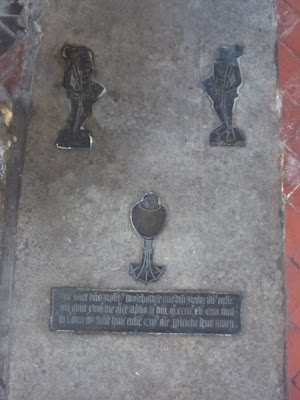
However I didn't miss the brass commemorating Robert Wodehouse, the rector, who died in 1515. This is particularly interesting as it doesn't contain his image (unlike, say, that of the Rev John Wryght, d.1519, in Clothall), but instead features an inscription, a chalice and wafer, and two wild men, usually known as woodwoses. (There's a very relaxed woodwose lolling at the foot of a tomb in Aldbury.)
They feature on the Wodehouse coat of arms; they're both hairy and naked (as you'd expect wild men of the woods to be) except for a vine wound around their waists, and have long tangled hair. They carry simple clubs, branches torn from trees. They're crudely etched, but I like them. As far as I know, they're the only woodwoses on brasses in an English church (if you know otherwise, please let me know).*
In the door between the south aisle and the vestry (so there's little light behind it, which it difficult to see and photograph) is a 16th century Flemish roundel of the Nativity, which all the authorities overlook.
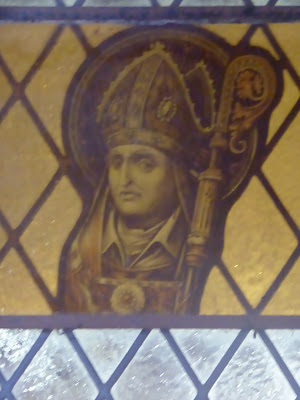
The Statutory Listing does notice this piece of glass, just above the roundel, of a bishop, of indeterminate date. It looks like painted, enamelled glass; possibly 18th or early 19th century.
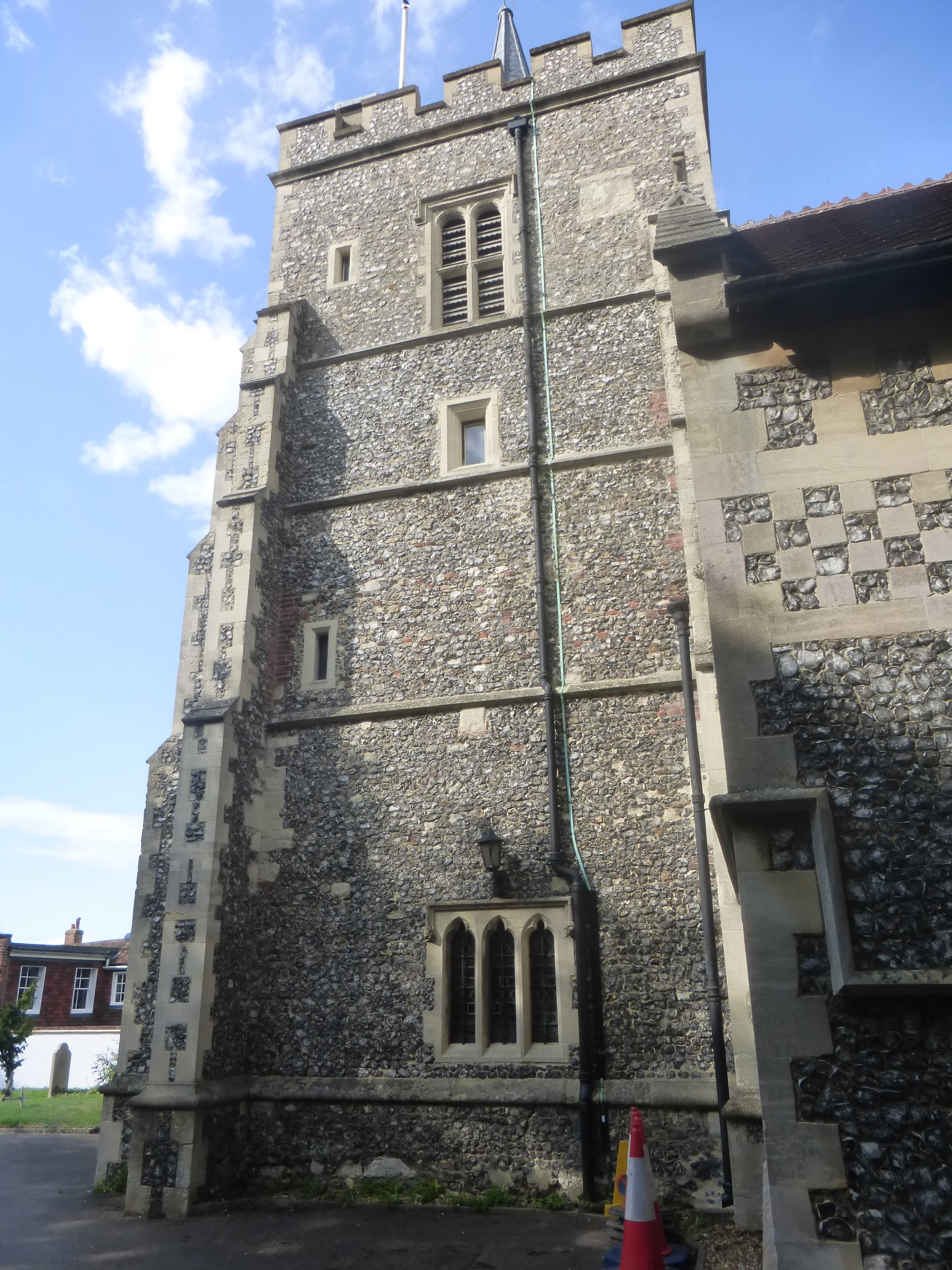
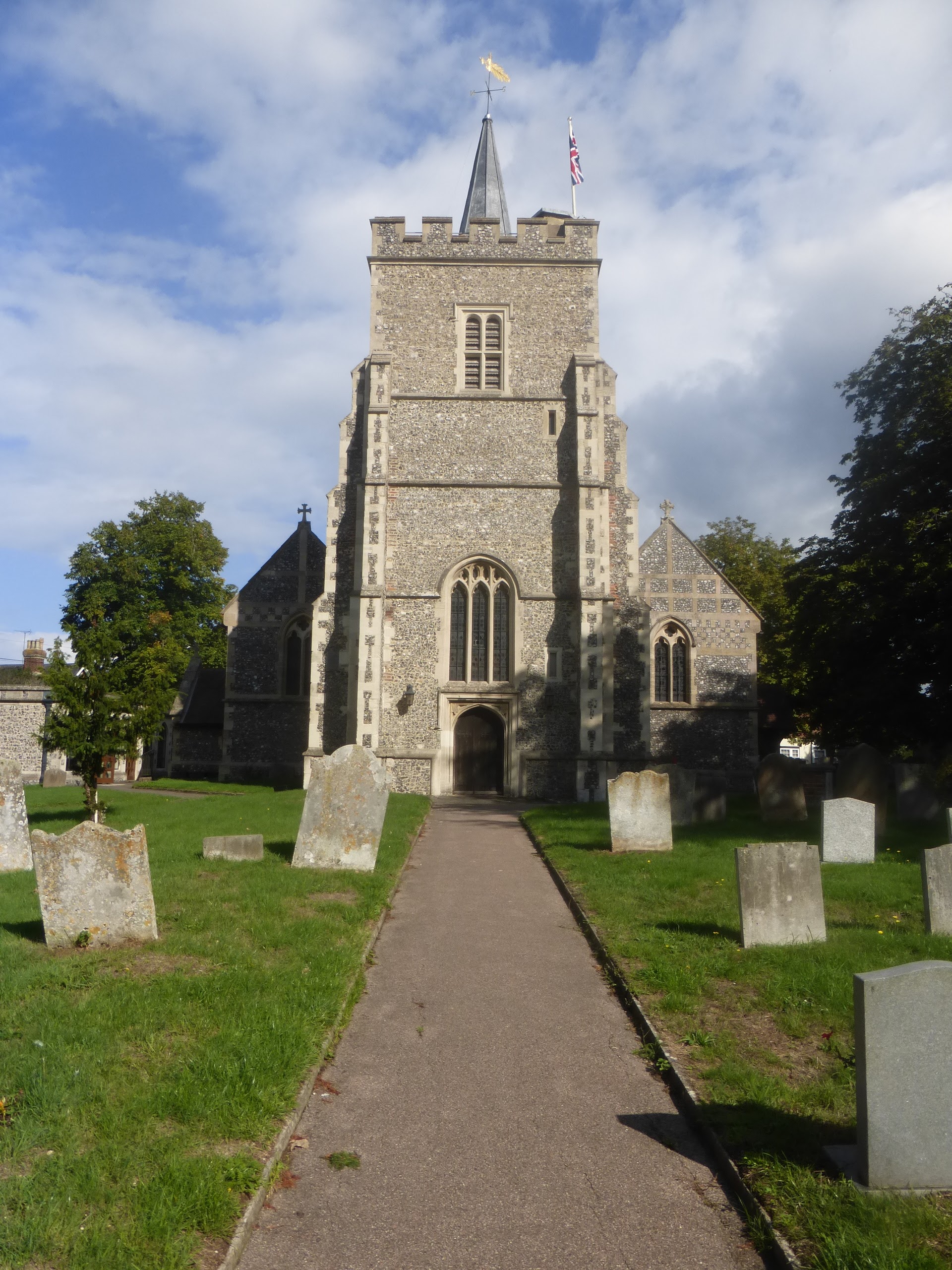
The church itself is routine but not unpleasing. The long sweep of the roof on the south of the nave and the south of the chancel is eye-catching. The south-west tower (with a pyramidal roof) doubles as the porch, like Clothall's (but, unlike Clothall, doesn't treble as the ringing chamber). The style is loosely the Victorians' and my favourite, Decorated, though there's a Perpendicular window on the north.
The mosaic reredos, installed in 1880, provides a glowing focal point for the church, embellished with spheres of coloured glass. The golds and deep blues are especially effective, and altogether it must be one of the best pieces of work of its kind in the county. Could it be by Powell and Sons, who were responsible for the outstanding mosaics in Waterford?
There are other, less spectacular, mosaics on the floor around the altar and font.
Also in the chancel is a coloured marble aumbry (the Statutory Listing calls it a ciborium), presumably from a similar date to the mosaics; coloured glass spheres feature here too. It's unclear if the columns are meant to be classical (Corinthian, perhaps?) or Gothic (stiff-leaf, perhaps?). I've not seen anything like it elsewhere.
The pulpit also seems to be a part of the same scheme as the mosaics.
The excellent Te Deum window in the north wall is by Hardman, 1879.
The equally good east window is by the same maker and of the same date; it shows the Nativity, Crucifixion and Noli Me Tangere.
Most of the other windows are by A L Moore, and aren't very good. But one of St Alban (1907) incorporates a near-photographic representation of the cathedral, when Grimthorpe's west front was only a quarter of a century old.
Holwell church was open when I visited, and gave the impression of being generally accessible. the church proves the adage that even not especially exciting-looking churches can have plenty of interest if you're willing to look for it.