|
| Byland Abbey, North Riding, Yorks |
A while ago I posted about a perfect pavement of mosaic tiles in Meesden church, Herts. Here are some others that I've seen recently.
Mosaic tiles are intricately shaped - for example, hexagons or segments of circles - and rarely have a picture or design on them, but fit together to make complex geometrical patterns. Large scale production started in about 1200, mostly in monasteries. Their manufacture and laying was labour-intensive and therefore expensive; monasteries, with their unpaid monks and lay brothers available to do the work, were able to afford them, however. From about 1250 regularly shaped - usually square or rectangular - tiles, decorated with designs, gradually supplanted mosaic tiles, and they seem to have ceased production by c.1325. (See here for a useful summary of medieval tile production.)

One of the biggest and best surviving displays of mosaic tiles is at Byland Abbey in North Yorkshire (or, if you prefer, and more historically accurately, the North Riding of Yorkshire). The church was built from 1177 into the early 13th century, which is when the tiles probably date from; (some of the conventual buildings are later). The building has been a ruin for almost five hundred years, though a substantial one which preserves the ground plan of a monastery extremely well, and the tiles are now in the open air. The woman in the ticket booth told me that they are normally covered, so I was fortunate to visit when I did.
The surviving tiles are all at the east end of the church, the 'holiest' part of the abbey which would have been deemed worthy of being expensively constructed. (The Cistercian order, to which Byland belonged, emphasised austerity and didn't allow superfluous decoration in their buildings; how the monks at Byland and other Cistercian establishments got away with their lavish pavements I don't know.) I believe that the tiles are in situ but have mostly been relaid.
Here's an anthology of mosaic tiles from Byland. As you can see, although the colours are badly faded, the ingenuity, variety and invention of the geometry remains dazzling.
A few miles from Byland is Rievaulx Terrace, a spectacular piece of 18th century landscaping. A flat grassy walk has been contrived at the top of a very steep and heavily wooded incline, which leads down to the ruins of Rievaulx Abbey. The trees grow so thickly that it would be impossible to see the ruins if it were not for several channels that have been cut in the woods through which promenaders on the terrace come upon different vistas of the abbey below. Furthermore, at each end of the terrace is a classical temple, the oblong Ionic Temple, and the circular Tuscan Temple (which is actually Doric; Professor Wikipedia explains the difference here).
The interior of the Tuscan Temple isn't accessible to visitors, but the view through the windows is good. The floor consists of more 13th century mosaic tiles from Byland, taken from there in the 1920s and relaid. Having been undercover for the best part of a century (and perhaps whoever took them chose the best-preserved ones), they look to be in better condition than those still in situ.
Rievaulx Abbey itself has some in situ mosaic tiles, which were mostly covered on the day of my most recent visit, but there are some on display (unnecessarily behind glass) in the visitor centre.
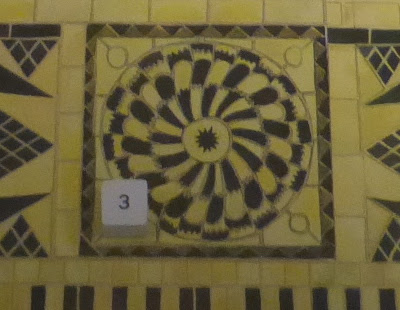
This close up reveals how complex some of the tile shapes are. Notice for example the shape in the middle of the circles in the photo above: it's like a cogwheel, with two of the cogs as points. Manufacturing tiles like this must have been a very complex and fraught business.
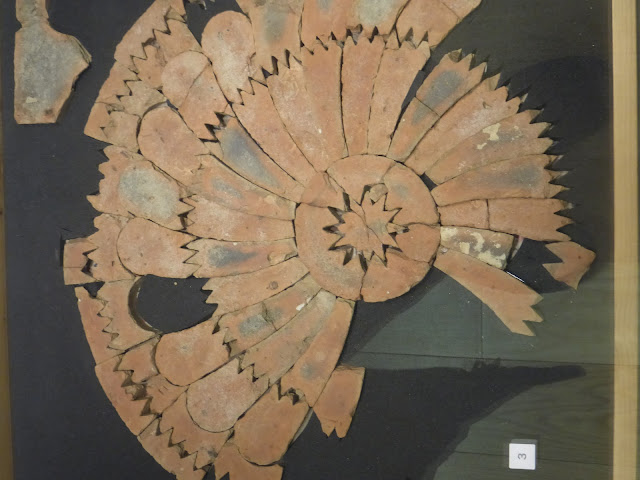
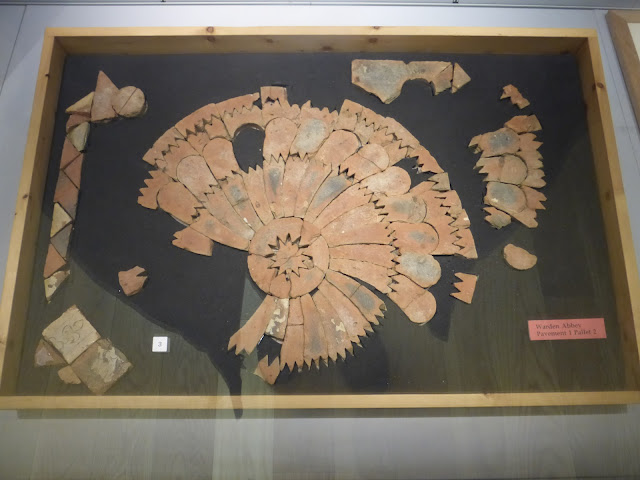
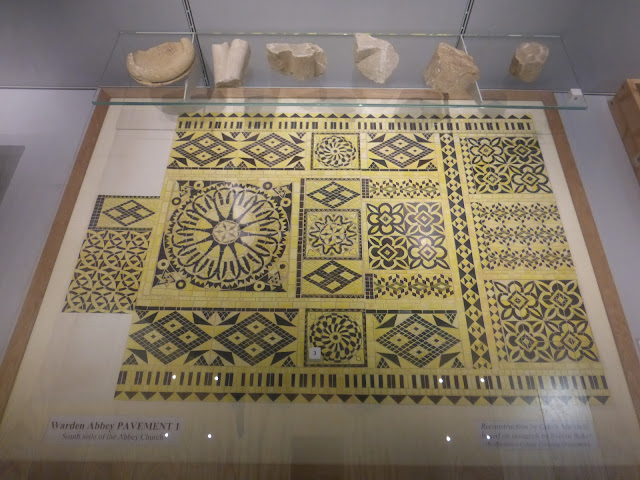
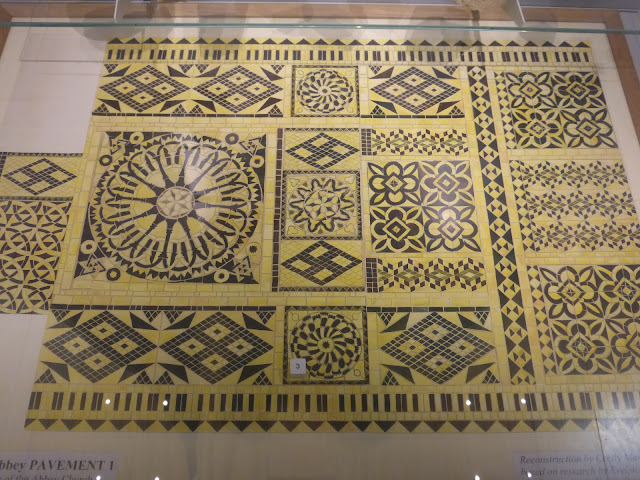
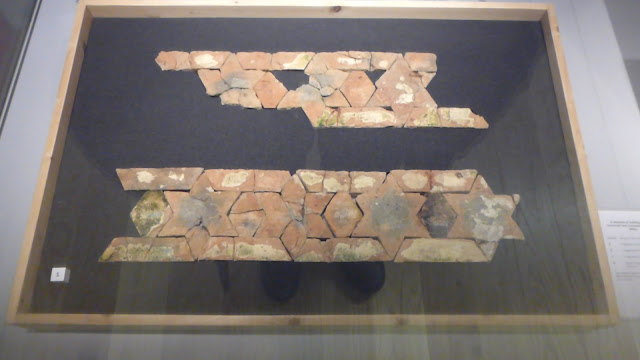
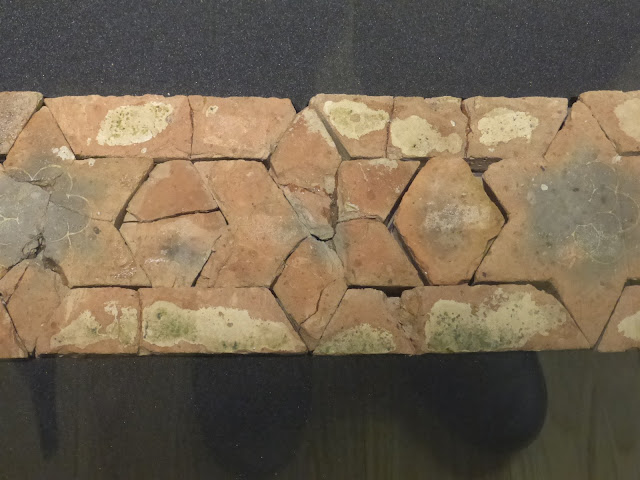
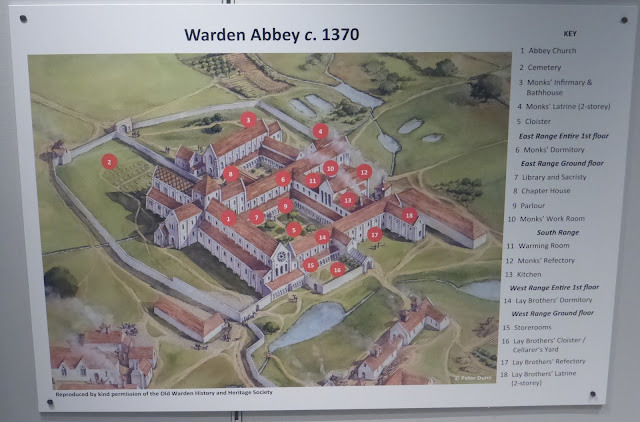
What seems to be among the last laid pavements of mosaic tiles is in Prior Crauden's chapel, a few yards south of Ely cathedral. This dates from c.1324. The peripheral patterns are very similar to those in Meesden, which is only about 40 miles away; it seems likely that they were made by the same tilers. The tiles include some stamped with geometrical designs, known a line-impressed tiles. Other tiles from the same workshop have been found in Warden Abbey, Beds (which was demolished in 1552, but some tiles have been excavated and are displayed in the excellent Higgins Museum, in Bedford), and Norton Priory, Cheshire, which I've not visited.


What makes the tiles in Prior Crauden's chapel so special are the opus sectile panels. Opus sectile (literally 'cut work') tiles aren't geometrically shaped, but are cut in the shape of whatever they depict. So in the photo below, one of 14 lions, each slightly different, the body of the animal is composed of twelve irregularly shaped tiles, including its majestic tail.

Most elaborate of all is the central panel in front of the altar, depicting Adam and Eve and the serpent with the Tree of Knowledge. Eve is on the left with pieces of fruit apparently in both hands; she offers one to Adam with her right. The serpent is human-headed and twists itself/himself around the tree and stares malevolently and intently at her, inducing her to eat the fruit, and/or to give it to Adam. (As the tiles are all worn and faded, the serpent is rather difficult to make out in these photos, and in the chapel, but the photo at the bottom has been adjusted to make the head clearer.) Adam, on the right, stretches his left hand out eagerly.


It's possible that the mosaics were originally intended for the Lady Chapel, which was being built on the north side of the cathedral when the central tower collapsed in 1322. (Indeed, the tower may have collapsed partly because the excavations necessary for laying the foundations of the Chapel weakened the tower's own foundations.) This collapse necessitated a complete rebuilding of the central part of the cathedral - resulting in the Octagon, the most wonderful Gothic structure to be found anywhere - which would have been extremely expensive. Perhaps a scheme to have an elaborately tiled floor in the Lady Chapel was abandoned as a cost-saving measure, and the tiles that had already been made and delivered were recycled in Prior Crauden's chapel. (The Lady Chapel has a boss depicting Adam and Eve as a substitute for the opus sectile pavement.) If this is so, the Chapel's loss was very much the chapel's gain; it's a magical experience to enter the chapel (having found the key, which is unnecessarily difficult), climb the narrow spiral staircase and roll back the carpets to see the almost unique tiles.